What-If Wednesday: Restructuring College Football in 1992 with the 24-Team Playoff
A pivotal year in sending college football down the path to the unrecognizable mess it is today offers possible solutions for both Playoff proponents and traditionalists.

With Big Ten Conference commissioner Tony Petitti doubling down on his desire for a 24-team College Football Playoff, postseason doomsdayers appear to be on the precipice of again being proven correct. Unfortunately, Petitti’s Playoff push also comes amid a Big Ten media-days week that suggests a college football super-league — ergo, NFL Lite with the Big Ten and SEC excluding the rest of the sport — may be inevitable.
Every iteration of postseason expansion since the 1998 inception of the Bowl Championship Series has been a vehicle for consolidating more control (and money) within an ever-shrinking cohort of programs. That might seem dubious in light of Cincinnati landing in the 2021 Playoff and the expanded, 12-team tournament reserving a bid for at least one qualified non-power conference representation — and this past season, featuring two such teams! — but consider this:
Cincinnati, the only Group of Five (now Six) program to participate in the four-team Playoff, almost immediately thereafter left the American for the automatic-qualifying Big 12.
UC’s move to the Big 12 coincided with UCF — which should have been the first-ever Group of Five member in the Playoff — also leaving the American.
Both Cincy and UCF now share a league with Utah, which in many ways was the primary catalyst in college football moving away from the BCS and toward a Playoff. Utah being denied a shot at the BCS National Championship and Associated Press voters failing to split the title at the conclusion of the 2008 season, despite the Utes finishing as the lone undefeated in Div. I, underscored football’s monopolization by somewhat arbitrarily determined Haves. Shortly after Utah’s denial led to antitrust lawsuits, the automatic-qualifying Pac-10 added the Utes in 2011.
Rather than leveling the playing field as it concerns a national championship, postseason “fixes” only served to further damage the outsider conferences. And in 2026, after years of conference-bloat, what’s considered an outsider league has basically applied to all but two.
In a perhaps ironic twist, however, the introduction of a 24-team Playoff decades earlier may have prevented the impending super-league format. A tournament alone wouldn’t have accomplished this, mind you, but combined with a few other regulations, just might have provided a solution.
Let’s take it back to the 1992 season as the case study in this exercise. While 1998 and the introduction of the BCS provides another natural jumping-off point for this edition of What-If Wednesday, it’s necessary to begin at 1992 for the sake of one of the most important regulations to this vision for college football:
1. All qualifying conference champions make the field.
That this isn’t even a consideration mentioned for the future 24-team Playoff is asinine to an unspeakable degree. I understand limiting the Group of Six to a lone guaranteed bid in the 12-team format, but to not include every conference champion in a field as large as 24 entrants seems to render the entire purpose of such a swollen field moot.
The Football Championship Subdivision has included every champion of a conference that chooses to participate in the NCAA Playoffs since expanding to 20 entrants in 2010 (and to 24 in 2013), and it doesn’t hurt the tournament.
2. A qualifying conference must have a minimum of eight and maximum of 10 members.
A general rule of thumb when something about college football is that the SEC is probably to blame in some capacity. Conference bloat and the introduction of previously unnecessary league championship games began with the SEC adding Arkansas and South Carolina in 1992, thus swelling to 12 members.
By capping membership at 10, conferences are better equipped to crown a champion without needing a championship game. An equal-length regular season across the sport means no one league has an advantage through that extra annoying finger quotations data point.
Further, when the FBS went to 12 regular-season games as the standard in 2006, I loved that the Pac-10 competed in an all-league round robin.
Now, there are drawbacks to a nine-game conference schedule; the most evident is the imbalance between home and away matchups. What’s more, a nine-game conference schedule in an 11-game season ruins the potential for high-profile non-conference matchups — and with a 24-team Playoff, capping the regular season at 11 games is pretty important.
Thus, 10-team leagues don’t get a full round robin, which can lend itself to some messy situations. The Big Ten concluding the first BCS season with a three-way tie between Michigan, Ohio State and Wisconsin, all at 7-1, is perhaps the most glaring example. Such a scenario is also much more exception than rule, and in this specific instance, a direct result of an eight-game league slate in an 11-team conference.
WIth that, here’s the Press Break What-If Wednesday restructuring of college football in 1992, and the resulting 24-team College Football Playoff.
ACC
Clemson
Duke
Florida State
Georgia Tech
Maryland
North Carolina
NC State
South Carolina
Virginia
Wake Forest
With 21 years to mend fences after its initial departure from the Atlantic Coast Conference in 1971, South Carolina is a logical partner to join Florida State moving from independence in 1992. Bobby Bowden’s burgeoning powerhouse in Tallahassee arrived as the immediate heavyweight of ACC football and effectively monopolized the crown through the ‘90s.
To that end, another fascinating what-if topic spinning off of this one is if Miami went along with its rival Seminoles in 1992 when the Hurricanes were still near their pinnacle. Given Maryland’s longstanding gripes with the North Carolina schools over basketball, there exists somewhere in the sports multiverse a timeline in which Miami and Maryland simply swap places in the ‘90s.
However, we won’t go that far down the rabbit hole — or I suppose wormhole is more fitting in the context of String Theory.
BIG 8
Colorado
Iowa State
Kansas
Kansas State
Missouri
Nebraska
Oklahoma
Oklahoma State
The Big 8 Conference had a good thing going, reflected in the few years preceding 1992 when it sent two teams to basketball’s National Championship Game (Kansas and Oklahoma in 1988), and boasted a split national champion in football with Colorado in 1990. Meanwhile, longtime football powerhouse Nebraska was also on the cusp of its most-dominant stretch in program history.
Expanding into the Lone Star State with the implosion of the Southwest Conference in 1995 and becoming the Big 12 was the logical economic move at the time. But by adding Texas specifically, the former Big 8 injected a lethal dose of poision that not-so-slowly moved the conference onto the verge of extinction.
Texas vs. Kansas and The Death of the Big 8 Conference
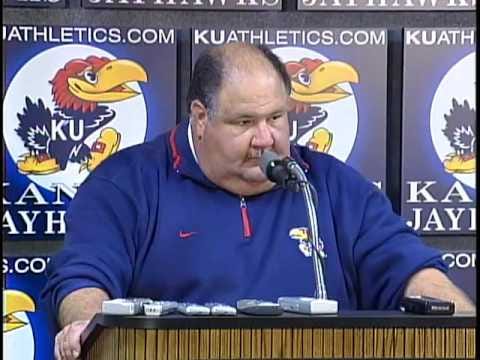
Kansas-Texas isn’t a particularly noteworthy college football series on its face. Dominated by the Longhorns for almost its entirety since 1996, the record sits at 17-2 Texas post-World War II.
Even with the parameters laid out for conference affiliation above, the Big 8 expanding to 10 would probably be inevitable and perhaps the Southwest Conference would still have destined to die. However — and spoiler for the next edition of What-If Wednesday — eschewing Texas for BYU and Utah could have been the better long-term play.
BIG EAST
Boston College
Miami
Penn State
Pitt
Rutgers
Syracuse
Temple
Virginia Tech
West Virginia
Among the most frustrating what-ifs from this era of college football is how the landscape might have differed had Penn State joined the Big East, not the Big Ten, in the early 1990s. But that’s a topic we’ll get into with much greater detail once Press Break restarts the Dead Conferences series (coming soon in 2026!).
Without getting into the specifics of why it didn’t happen, I’ll simply lament that the Nittany Lions didn’t forge a conference rivalry with in-state counterpart Pitt — which, as Craig Meyer chronicled at The Front Porch, was not far removed from being a national powerhouse by the early 1990s.

Miami, meanwhile, was still at its peak with a share of the 1991 national championship. What’s more, the 1987 Fiesta Bowl provided the foundation for a built-in, Thanksgiving Weekend rivalry game between the Hurricanes and Penn State.
While the bottom of the Big East was weak at this time — namely Rutgers and Temple — Frank Beamer was on the cusp of leveraging Thursday night ESPN broadcasts to build Virginia Tech into a contender. What’s more, applying the metrics stated below, the Big East would have sent three teams to a 24-team College Football Playoff in 1992.
BIG TEN
Illinois
Indiana
Iowa
Michigan
Michigan State
Minnesota
Northwestern
Ohio State
Purdue
Wisconsin
Numerically named conferences failing to update commensurate with expansion is my most superficial yet longest enduring frustration stemming from realignment. I have mentioned before here at Press Break that 1993 was the first college football season I followed closely, and that also marked Penn State’s debut in the Big Ten. The Nittany Lions made 11, and as an elementary schooler I was irrationally triggered by an eleven-team league calling itself 10 — even if it incorporated some clever work in its rebranding to acknowledge the deviation.

Upon adding Nebraska to reach 12, Rutgers and Maryland for 14 and destroying the Pac-12 with the pillaging of Oregon, UCLA, USC and Washington to total 18, the Big Ten couldn’t even be bothered to construct a fun logo out of its bloat. Sure, the modern “B1G” icon avoids invoking any specific number beyond the 1 as an i signaling an ever-changing digit in the teens.
But when the super-league comes to pass and the Big Ten-Plus-However many expands into the 20s, what then? Embarassing stuff from the alleged academic stronghold conference.
Oh yeah, anyway…the Big Ten was good at 10, is my point, and it’s ongoing run of national championships all coming from original members only emphasizes that.
BIG WEST
Boise State
Cal State Fullerton
Idaho
Nevada
New Mexico State
Pacific
San Jose State
UNLV
Utah State
Big West football limped along for almost another decade from this juncture, but was very much on life support by 1992. Long Beach State shuttered its program in 1991, and Cal State Fullerton followed suit a year later. Pacific was the next to go under in 1995.
Dead Football Conferences, Part 1 Chapter 1: Big West Football Was Born To Die

Completion of the 2023 college football season effectively signals the end of the Pac-12 Conference. It’s a reality that hasn’t truly sunk in for me.
For this reason, and to fill out its numbers to qualify for the Playoff, I expedited Boise State’s and Idaho’s jumps from Div. I-AA by four years. The Broncos’ and Vandals’ former Big Sky Conference counterpart Nevada made the switch after the 1991 season and remained in the Big West until its penultimate season of 1999.
The Wolf Pack won the Big West in 1992, fresh off finishing the 1991 Div. I-AA regular season ranked No. 1 before falling to an upstart Youngstown State team coached by Jim Tressel in the quarterfinals of the NCAA Playoffs.
Like Nevada in 1991, Idaho ascended to near the top of the Div. I-AA polls in 1992 and played in a rare No. 1 vs. No. 2 regular-season contest. Had that same Vandal team been in the Big West, I don’t doubt they’d have contended for and probably won a spot in the Playoff. More on that in a bit.
CONFERENCE USA
Army
Cincinnati
East Carolina
Louisville
Memphis
Navy
Tulane
Tulsa
Conference USA launched in 1996, thanks in part to the collapse of the Southwest Conference and longtime independent football programs that made up leagues like the Metro and Great Midwest searching for gridiron homes.
The nature of this exercise expedites the debut of Conference USA by a few years. All were independents in 1992, and none finished with a record better than 6-5. Coincidentally, 6-5 Memphis played five of the seven other programs included above — the service academies being the exceptions — and the Tigers finished 4-1 against them.
The loss came to Louisville, 16-15 in Week 2, and was among all five Memphis defeats by five points or fewer. Three of those came against SEC opponents Ole Miss, Mississippi State and Tennessee.
MID-AMERICAN
Akron
Ball State
Bowling Green
Central Michigan
Eastern Michigan
Kent State
Miami U.
Ohio
Toledo
Western Michigan
MAC football first began to truly command the national spotlight at the end of the ‘90s, with Heisman Trophy contenders in 1997 (Randy Moss) and 1998 (Daunte Culpepper), and the first media darling fans wanted to crash the BCS party in 1999. Each of those instances come from programs (Marshall and UCF) not yet in the MAC in 1992 — or Div. I-A football at all, for that.
Nevertheless, a forerunner to what we know today as MACtion existed in the Bowling Green teams of the early 1990s. The Falcons ran the table in conference table in both 1991 and 1992, won a combined 21 games during that team, and held off Nevada in a wild, first-ever installment of the Las Vegas Bowl.
PAC-10
Arizona
Arizona State
Cal
Oregon
Oregon State
Stanford
UCLA
USC
Washington
Washington State
As the football gods intended it to be. On the gridiron Valhalla, Keith Jackson calls the action from sun-kissed stadiums — or the occasional snow-covered rivalry contest — kicking off at the ideal time of 12:30 p.m. PT.
SEC
Alabama
Auburn
Florida
Georgia
Kentucky
LSU
Ole Miss
Mississippi State
Tennessee
Vanderbilt
Did you know??? Since expanding to 12 teams with Arkansas and South Carolina in 1992, then Texas A&M and Missouri 20 years later, then again with Oklahoma and Texas in 2024, none of the newcomers have won the SEC football championship?
SOUTHWEST
Arkansas
Baylor
Houston
Rice
SMU
Texas
Texas A&M
TCU
Texas Tech
As eluded to above in regard to the Big 8, there may have been no saving the Southwest Conference. SMU’s decimation in the wake of receiving the NCAA’s death penalty, less severe but still detrimental penalties handed down to Houston, the longstanding struggles of members Baylor, Rice and Texas Tech (to a lesser extent) and Texas being…well, Texas…made for a volatile situation.
Regardless, the SWC was still alive in 1992. Maybe with college football adopting a new era, someone could have locked the members of the conference in a room to force them to hash out or their issues.
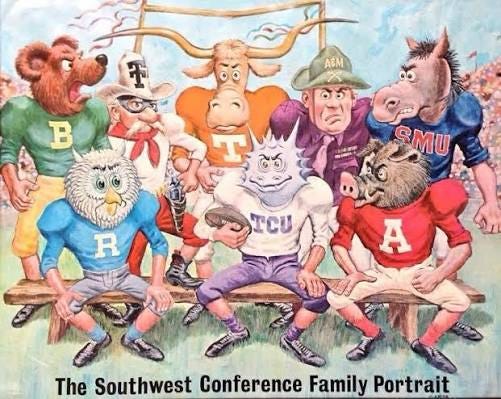
Or, perhaps in the case of Arkansas, the Razorbacks could have crafted a pitch for membership in the Big 8 instead of the SEC.
SUN BELT
Arkansas State
Louisiana
Louisiana-Monroe
Louisiana Tech
North Texas
Northern Illinois
Southern Miss
UAB
Of the conferences featured in this What-If Wednesday, the Sun Belt was the last to host football with its debut coming in 2001. The original incarnation of Sun Belt football was a geographic mess, with Idaho joining North Texas and New Mexico State as refugees from the imploded Big West.
The above version’s geographical outlier is Northern Illinois — DeKalb isn’t exactly the first city that comes to mind when one hears the word “Sun” — but NIU’s presence at least keeps the league confined to a single time zone.
Louisiana-Monroe and North Texas didn’t transition to Div. I-A until 1994 and 1995, and UAB operated as a non-scholarship, Div. III program until 1993. That’s a lot of fudging reality, to be sure, but by no means as preposterous as Stanford being in a conference with Florida State.
WAC
Air Force
BYU
Colorado State
Fresno State
Hawai’i
New Mexico
San Diego State
Utah
UTEP
Wyoming
Western Athletic Conference football went through several different iterations, and vestiges of it still exist in the present-day United Athletic Conference. However, the version that existed after Arizona and Arizona State left to turn the Pac-8 into the Pac-10, and before the WAC expanded to a preposterous 16 members late in the ‘90s, was Peak WAC.
The WAC produced a national championship-winning BYU team in 1984, the Heisman Trophy winner in Cougars quarterback Ty Detmer in 1991, and during this 1992 season had another Heisman finalist with San Diego State running back Marshall Faulk.
Two WAC teams also finished the 1992 season ranked in the Top 25, with league champion Hawai’i at No. 20 and Fresno State at No. 24.
Notre Dame
Notre Dame maintaining independence has been a controversial topic for as long as I’ve followed college football and has only intensified with postseason expansion. Personally, I appreciate Notre Dame holding onto a tradition while so many other traditions disappear from the sport.
I do understand complaints about the Fighting Irish having unfair exceptions, however. To that end, Notre Dame embarks on this hypothetical new era with a schedule format that both continues the program’s historic rivalries, gives the Irish a format that closely emulates the rest of the nation’s conference scheduling, and still allows for fresh, marquee matchups like the unforgettable showdown with Florida State one year after this.
Notre Dame plays its five primary rivals: Michigan, Michigan State, Navy, Stanford and USC. As part of other Irish sports belonging to the Big East, the Golden Domers face three Big East football opponents per season on a three-year rotation. That then leaves three other dates to fill. The end result produces…Notre Dame’s actual 1992 schedule:
Sept. 5 vs. Northwestern (at Soldier Field in Chicago)
Sept. 12 vs. Michigan
Sept. 19 at Michigan State
Sept. 26 vs. Purdue
Oct. 3 vs. Stanford
Oct. 10 at Pitt
Oct. 24 vs. BYU
Oct. 31 vs. Navy (at Giants Stadium in New Jersey)
Nov. 7 vs. Boston College
Nov. 14 vs. Penn State
Nov. 28 at USC
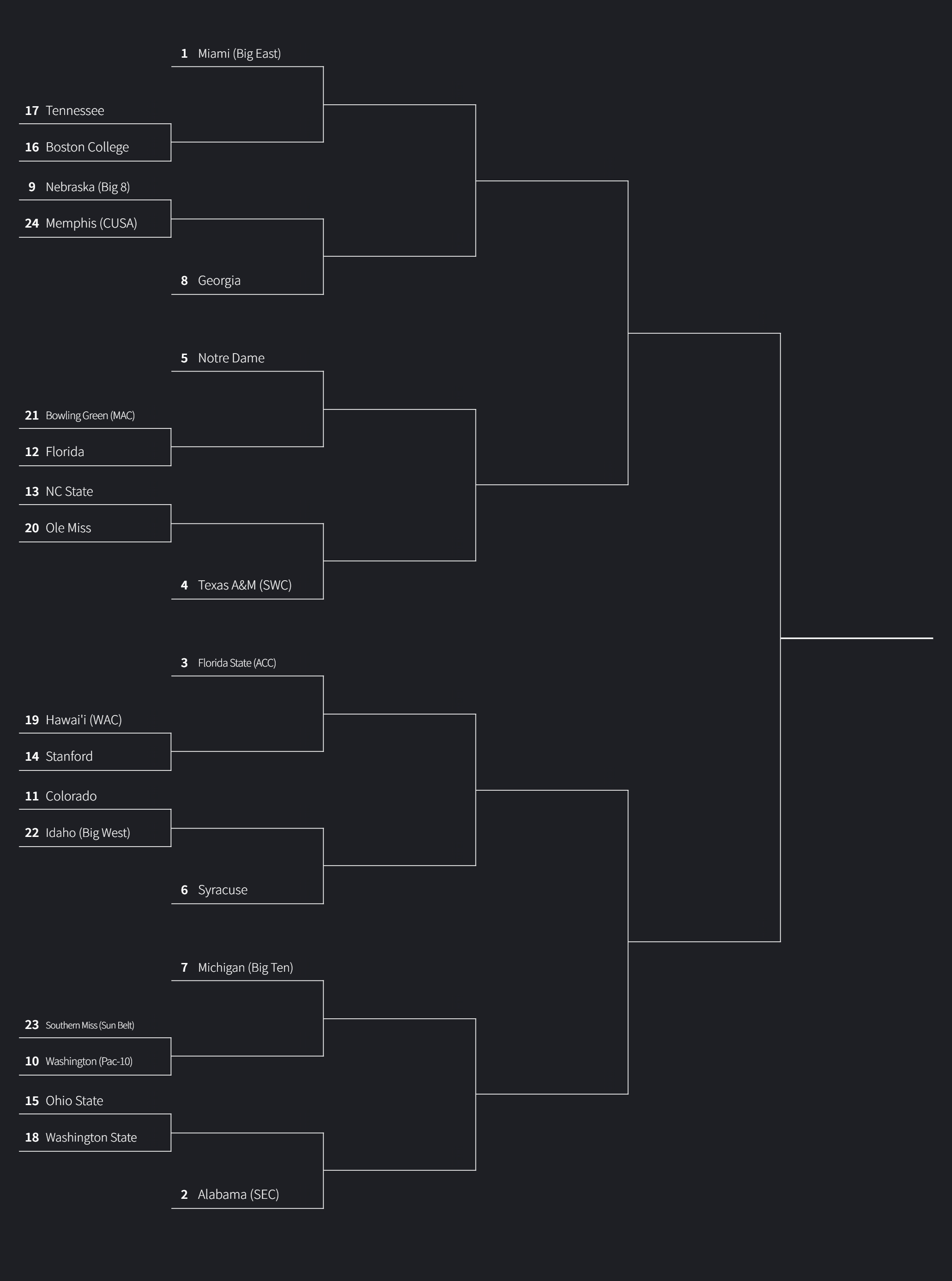
So with that, here’s your resulting 24-team Playoff bracket. I based seeding primarily on AP Top 25 rankings at the conclusion of the regular season, albeit with considerations for some circumstances. For example, Colorado finished the 1992 regular season at No. 9 in the AP Poll, but No. 11 Nebraska won the head-to-head matchup — handily — and thus held the Big 8 championship tiebreaker.