
Mid-Major Monday: Let's Talk About The Ceiling for Miami
The undefeated RedHawks have Oxford's best team since 1999. Can the 2026 Miami team match that season's success?

Of all the surprise stories around college basketball midway through the 2025-26 season, the undefeated start for Miami University may be the most intriguing.
One could have understandably dismissed its perfect record through the first 13 games, with three of the RedHawks’ wins coming against non-NCAA Div. I opponents and only a single victory over an opponent ranked better than No. 250 in KenPom metrics.
But since diving into conference play, coach Travis Steele’s Miami team deserves your full attention.
The RedHawks scored their two best resume wins on their way to 14- and 15-0 with a 93-83 defeat of Bowling Green (KenPom No. 112, NET No. 99) on the road last Tuesday, and a 76-73 victory over Akron on Saturday at home.
The latter came against the reigning MAC champion and preseason favorite, with the Zips ranked No. 56 in KenPom and No. 50 in NET.
Saturday’s matchup in Oxford — the premier event involving a Miami and team from an Oxford on this month’s sports calendar, no doubt — marks the only regular-season meeting between teams that look to be the class of the conference.
While that’s a bummer for connoisseurs of mid-major basketball, it’s created a fascinating scenario: KenPom’s projected results for the remainder of the season have Miami running the table.
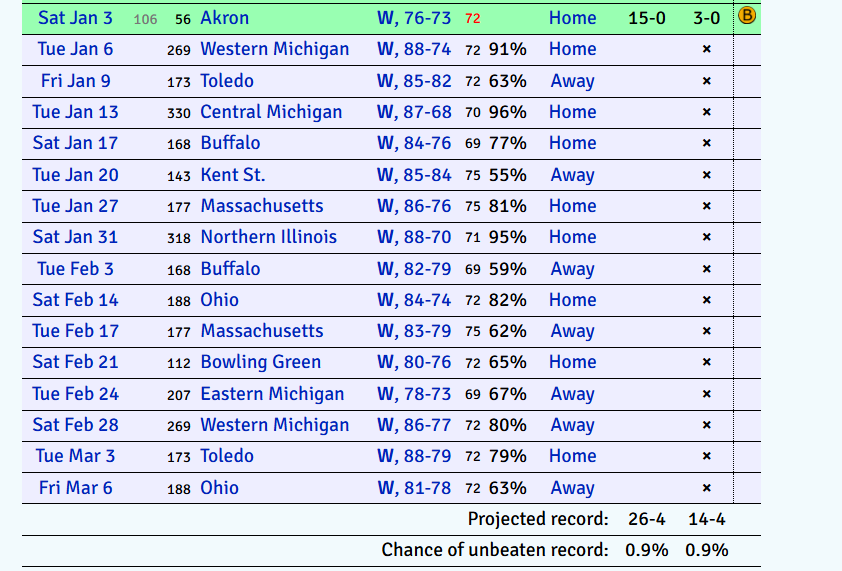
Now, upsets happen, which is why no team has gone into March Madness undefeated in more than a decade. It also makes the grousing between camps arguing whether Arizona or Michigan should be ranked No. 1 a little silly, given the two play in leagues that are absolute gauntlets and a loss for either seems unavoidable.
Likewise, as you can see, Miami’s forecasted chance of going 30-0 is a scant 0.9 percent. Earnest discussion as to whether or not the RedHawks can get there when they’re only halfway is premature.
That it’s a chance at all this deep into the season is remarkable, though, and reflective of the impressive resurgence for a program that was once a standard-bearer in the mid-major ranks.
And that means, as is customary here at Press Break, it’s time for some historical context!
Although the label “mid-major” is more of a 21st century construct, the Mid-American Conference was arguably the banner-carrier for that nebulous collection of basketball programs in the 1990s.
“The Shaq of the MAC” Gary Trent at Ohio U. Eastern Michigan’s Sweet 16 run in 1991 and upset of Duke in 1996. Ball State’s Bonzi Wells posting insane stats for four years. Spilling over into the new millennium, there was the Antonio Gates-led Kent State team that very nearly crashed the Final Four.
Pro Football Hall of Famer Antonio Gates and The Glory Days of MAC Basketball

Most anyone with even a cursory knowledge of 21st century pro football knows Antonio Gates played college basketball. It’s a fun tidbit that came up repeatedly throughout Gates’ 16-year NFL career, culminating with his induction into the Pro Football Hall of Fame.
But perhaps best of the bunch among the MAC programs in this era was Miami University. The RedHawks reached four NCAA Tournaments in the ‘90s and advanced twice, extending a run that began with three straight appearances in the mid-1980s.
Miami garnered considerable national buzz for its upset of Arizona in the 1995 Tournament, thanks in no small part to big man Devin Davis. Recognizable for his unique hairstyle, Davis got an article in SLAM when it was the publication for hoopheads and a bagel shop in Oxford named an order for him (cream cheese and ‘Lox).
A 15-year era of success coinciding with perhaps the top-to-bottom strongest period for MAC basketball reached a crescendo with the 1998-99 campaign. Miami reached the AP Top 25 and Wally Szczerbiak earned All-American recognition in a season that concluded with a trip to the Sweet 16.
Szczerbiak carried the RedHawks to the second weekend of the tournament in what was as close to a one-man show as you’ll see in the Big Dance, and one of the best postseason performances of modern times1.
The 1999 NCAA Tournament was also Miami’s last until 2007, which in turn marks the most recent year the RedHawks moved onto March Madness. Miami’s 24 wins in 1998-99 were also the program’s high by a considerable margin — and, in fact, its only 20-plus-win season — until 2024-25.
Quietly, the groundwork for Miami’s outstanding 2025-26 was laid a season ago when the RedHawks won 25 games a season ago. The RedHawks reached the MAC Championship Game and took Akron to the brink.
After such a stellar campaign, perhaps it’s dismissive to deem last season as “quietly” setting the foundation for Miami this year. The RedHawks were picked second in the preseason MAC poll, hardly being overlooked, and returning guard Peter Suder was named preseason 1st Team All-Conference.
However, with Akron garnering 11-of-13 first-place votes and three preseason All-MAC selections to Miami’s two, the RedHawks entered 2025-26 still very much in the Zips’ shadow.
Saturday’s win is thus noteworthy both for notching Miami its first KenPom top 100 victory, and moving the RedHawks into the forefront of the conference’s conversation. That, in turn, means Miami is a potential March breakout team to follow in the coming months, regardless if it runs the table or not.
The RedHawks are also worthy of your attention for the brand of basketball they play under Steele. Miami’s among the nation’s most effective offensive teams, averaging 93.9 points per game — ninth-highest in Div. I — with near-40 percent team 3-point shooting average.
And, while past standout Miami teams built around individual superstars in Davis and Szczerbiak, this RedHawk squad is notable for its balance. Five players are scoring in double-figures per game and none more than 2024-25 MAC Rookie of the Year Brant Byers’ 15.4.
Now, Byers is the kind of player whose move to a brand-name program seems inevitable in this age of college basketball: A 6-foot-8 wing who both shoots from deep at a prolific rate and gets to the rim effectively. His two-most productive scoring performances also came in Miami’s marquee non- and conference wins over Akron (26 points) and Horizon League front-runner Wright State (27 points).
Whether or not the portal comes calling eventually, though, Byers fits nicely into the framework of a true team effort. Miami owes its scoring proficiency to effect ball movement, notching more than 55 percent of its total made field goals off of assists, led by Suder’s 4.2 per game.
Rotational guard Luke Skaljac is just behind Suder at 4.1 dimes a contest and Evan Isparo — Miami’s second-leading scorer at 13.9 points an outing — is dishing 3.3 assists per game.
Miami’s production is a testament to chemistry and cohesion, with all of the above-mentioned names in at least their second season with the program. It’s an increasingly difficult formula for coaching staffs in the present-day game, and the chief cause for concern among those (justifiably) concerned that March Cinderellas are bound for extinction.
In keeping so much of a quality roster in tact, Steele has a classic Cinderella-style roster capable of a serious run come Tournament time.
Keep this in your back pocket, as it’s a teaser for something coming soon to Press Break.